爱情公寓2
Air France-KLM tells GT their ban on portable air conditioners as baggage at Shanghai airport 'out of operation, safety reasons'_我的网站

A |
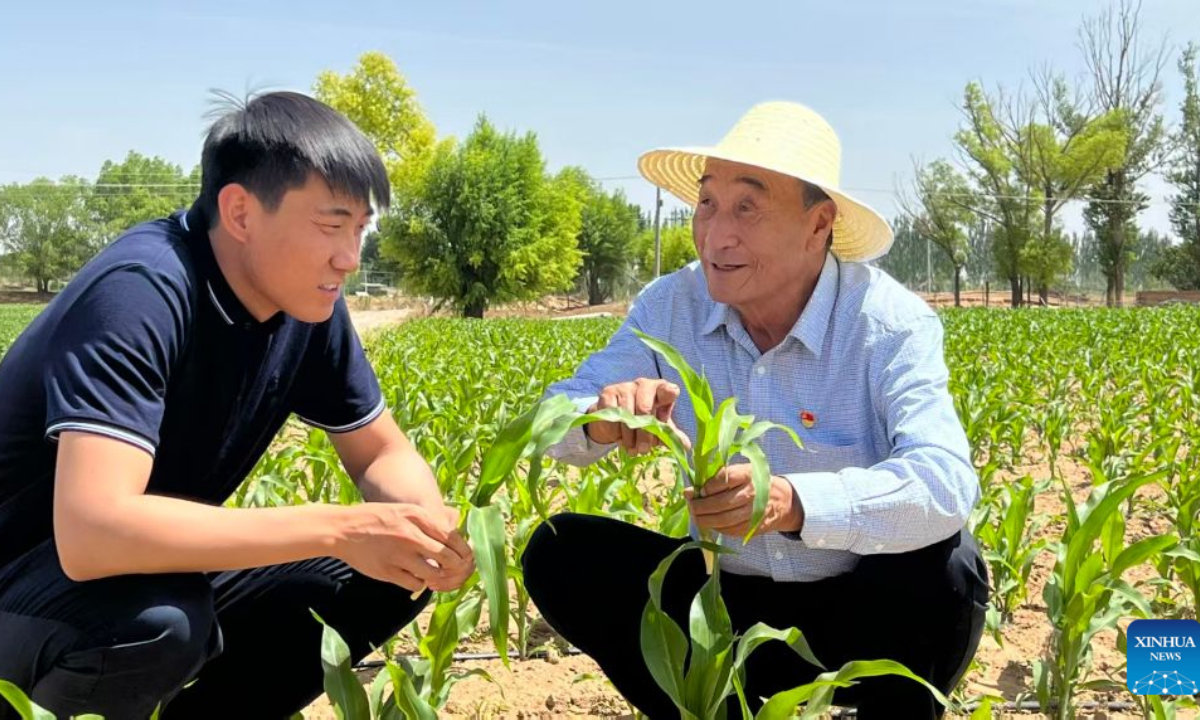
At 29, Shi belongs to a new generation of desert-control workers equipped with drones, machines and remote irrigation systems. An earth auger can now do in a day what once required about 200 laborers, while a single phone can control drip irrigation across more than 1,000 mu (about 66.67 hectares) of woodland.
For the older Shi's generation, the challenge was getting trees to survive in moving dunes. For the grandson, it is figuring out how to make those forests healthier and more resilient for decades to come.
Their story captures a broader shift in desert control along the southern edge of the Maowusu Desert in northwest China's Shaanxi Province: turning shifting sand into forest was only the beginning.
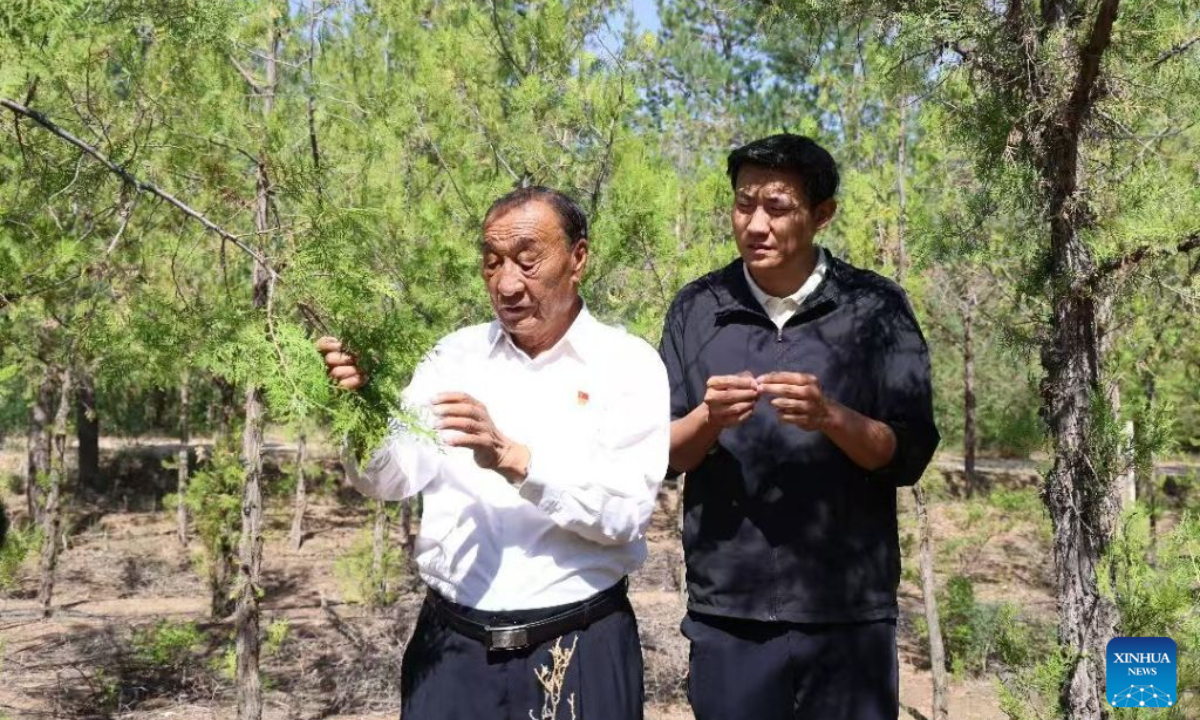
In 1986, Shi Guangyin, Shi Jianyang's grandfather, led more than 300 villagers into Langwosha, a sandy area in Dingbian County in Yulin City. He had raised 60,000 yuan (about 17,377 U.S. dollars at the time) by selling his family's 84 sheep and borrowing from relatives and banks to contract 3,500 mu of barren sandy land.
The early setbacks were severe. Strong winds destroyed about 90 percent of the saplings in the first year, and about 80 percent of those planted the following year failed to survive.
After seeking advice from forestry experts, Shi and the villagers laid out checkerboard-shaped barriers on windward slopes to hold the sand in place, then planted trees, shrubs and grasses within them. Sapling survival rates rose to about 80 percent.
Over the next four decades, Shi and those working alongside him treated 250,000 mu of sandy and saline-alkali land, with more than 53 million trees and shrubs taking root.
Greening the Maowusu Desert is part of a much larger national undertaking. It is one of the three major battlefronts of China's Three-North Shelterbelt Forest Program, a decades-long effort to curb desertification across northern China.
China has made desertification control a national ecological priority. Since 2023, the country has stepped up efforts under the program, with greater emphasis on systematic restoration and on consolidating earlier gains.
Decades after the first trees took root, a new challenge emerged. Poplars planted decades ago for their rapid growth began reaching the end of their life cycle, with large numbers of trees dying, while forests dominated by a single species were more vulnerable to pests and disease.
Making a forest was one challenge. Keeping it healthy for another generation is another.
Shi Jianyang grew up watching his grandfather and father work to hold back the sand. His father, Shi Zhanjun, spent years planting trees alongside Shi Guangyin before dying in a road accident in 2008 while transporting saplings.
As a boy, Shi Jianyang sometimes resented the work that had taken his father. He spent summer holidays in makeshift tents in the sandy land, eating meals gritty with sand. During planting season, his father would return home with painful blisters in his mouth.
Yet he eventually chose forestry himself.
After studying forestry technology in university, Shi returned home in 2020 and began working in desert control. His team, initially made up of just seven or eight young locals, later brought in university graduates with expertise in soil science, landscaping and pest control.
The younger generation faced a different question: not simply how to make trees survive, but how to make a forest last.
Shi and his team spent more than 40 days in a 5,000-mu woodland setting up sample plots, measuring rainfall, studying soil microorganisms and tracking tree lodging. They proposed renewing aging forests with better-planned forest structures and expanded the planting of Mongolian pine, a long-lived evergreen species that had been successfully tested locally.
To date, about 50,000 mu of land has been planted with Mongolian pine. As some trees fail to survive and require replacement in subsequent planting seasons, the cumulative area of planting operations has reached about 65,000 mu.
Technology has also changed daily work. Drones patrol forests from the air, mechanized equipment dig planting pits, and irrigation can be managed remotely. Sapling survival rates, which Shi Guangyin's generation had raised to about 80 percent through improved sand-control and planting methods, have climbed further to about 92 percent with greater mechanization and more precise management.
Shi said the changes can be felt on the ground. Strong sandstorms have become rare, winds are weaker inside the forest, and the ground stays moist longer after rain. Summer days beneath the trees also feel cooler, while morning dew appears more often. The changes lead him to rethink desert control.
His approach also reflects a broader effort in China's desert regions to link ecological restoration with local livelihoods, giving communities a stronger economic stake in protecting restored land.
With his grandfather's support, Shi and his team have been looking for ways to make better use of the restored land as ecological conditions improve. They have developed potato seedlings suited to sandy soil, promoted greenhouse farming, and set up a livestock cooperative, while increasingly growing potatoes, watermelons and peppers on land once prone to losing water and nutrients.
Shi has also turned to livestreaming e-commerce to market potatoes and other local farm produce, while developing forest-based health and leisure projects. More than 2,000 local residents have seen their incomes rise steadily as farming, livestock breeding and other businesses have developed.
"We used to fear the sand and keep away from it. Now we understand it and know how to make use of it," Shi Guangyin said. "Today, there are opportunities to make a living everywhere in this sandy land."
Across Yulin, forest coverage has risen from 1.8 percent in 1949 to 34.8 percent, while shifting dunes that once encroached on villages have been brought under control.
For Shi Jianyang, however, the green landscape is not proof that the work is finished. "Planting a tree is not difficult," he said. "The difficult part is looking after it for decades."
The grandfather generation learned how to stop the sand. The young generation is learning how to make what grew there last.
。

A Rednote post recently sparked discussion and jokes among netizens after showing a notice stating that "Air France-KLM does not accept portable air conditioners as checked or carry-on baggage," against the backdrop of extreme heatwaves in Europe this summer and the difficulty of securing one in European markets.
Air France-KLM customer service later confirmed to the Global Times on Monday that the restriction was in place, explaining that passengers' baggage must comply with relevant rules and requirements, which are established based on operational and safety considerations.
The discussion came as Europe has been hit by persistent extreme heat in recent months, triggered widespread heat alerts and a surge in local demand for air conditioners, a product that was not widely installed in European households.
After the RedNote post was released, some netizens shared similar experiences in the comments section, with one writing: "I just bought six small fans to take to Germany as gifts, [now that] Air conditioners are out of the question. But it seems the heatwave is finally over."
Some speculated that the sign was put up after travelers to Europe tried to imitate a widely reported case in which a Chinese employee based in Shanghai helped a French colleague visiting China on a business trip bring an air conditioner from China back to Europe by air in July.
The story was shared by the Chinese employee on RedNote. After researching different models, the Chinese selected a compact unit suitable for international transport based on its size and weight. The air conditioner reportedly used non-flammable R410A refrigerant, with a refrigerant charge of 350 grams, and contained no lithium battery. According to the post, the netizen concluded that the unit could be transported as regular baggage transport rather than being treated as dangerous goods.
The netizen also carefully consulted the ICAO technical instructions and IATA dangerous goods regulations to determine whether the air conditioner needed to be handled as dangerous goods, per the post.
The French colleague, with sufficient baggage allowance, only paid for additional packing services. The total cost came to 1,412 yuan ($209.26), including 1,260 yuan for the air conditioner, 130 yuan for airport packaging, and 22 yuan for a high-power European power adapter.
The French passenger was reportedly transported the air conditioner successfully and arrived in Barcelona.
However, airlines have reminded passengers that while some air conditioners may qualify for checked baggage, strict requirements still apply.
Battery and refrigerant restrictions must be followed, as portable air conditioners containing lithium batteries are strictly prohibited from being checked in. Meanwhile, size and weight limits must be considered as the equipment must comply with airline baggage allowances, which typically limit individual pieces to 23 kilograms or 32 kilograms, and total dimensions generally not exceeding 158 centimeters.
Professional packaging is also recommended, with travelers advised to use airport packing services to reduce the risk of damage during baggage handling.
Experts said that as Europe continues adapting to increasingly frequent heatwaves, the unusual trend of travelers carrying cooling equipment across borders highlights growing concerns over climate extremes, while also serving as a reminder that aviation safety rules remain a key consideration for transporting household appliances.
In second quarter of 2026, China-Europe freight trains have transported more than 100,000 portable air conditioners and key components, with a total cargo value of about $52 million, helping to ease supply pressures in the European market, according to a report by China Railway Group media.
。
Current article:http://pk31ms.shouyouxumianpouluanteng.shop/wvozq/utcvl.html
Published on:14:44:59
 微博
微博 银河护卫队2
 不结婚
不结婚 影视风云路
影视风云路 饭局狼人杀
饭局狼人杀 追梦赤子心
追梦赤子心 谍影重重
谍影重重 龙的传人
龙的传人


